The UAE’s deadline for large businesses to appoint an e-invoicing provider passed on 30 October 2026, and go-live is 1 January 2027. Appointing an Accredited Service Provider doesn’t finish the job. Your ERP, open source or not, still has to send that provider clean, complete invoice data on every sale and credit note.
That’s the part most readiness guides skip. They tell you to pick a provider and move on. But the provider only carries what your system gives it, and if your customer tax numbers are half filled in or your credit notes go out late, the provider can’t fix that for you. So here’s what changed in October, what the penalties really say, and what to check in your own system over the next eight weeks.
What changed in October
Two things happened close together. First, the date itself. The Ministry of Finance had already pushed the provider deadline for businesses with revenue of AED 50 million or more from 31 July to 30 October 2026, and it said in May that go-live on 1 January 2027 stays put. As of today that deadline is behind us. The Ministry’s list of Accredited Service Providers, updated on 2 November, now names 84 companies.
Second, the rules underneath moved. Ministerial Decision No. 197 of 2026, in force from 1 October, amends the core e-invoicing decision in four ways that matter to anyone running finance software:
- Tax groups get a break. Sales between members of the same VAT tax group are excluded for 24 months starting 1 January 2027.
- The clock counts business days. An e-invoice or credit note must go through the system within 14 business days of the transaction, up from 14 calendar days. VAT-registered sellers still have to meet the VAT Law’s own invoicing timeline, which the decision keeps in place.
- Data no longer has to sit in the UAE. The old rule said e-invoice data had to be stored inside the country. Now you keep it for the period the Tax Procedures Law sets and produce it when the Federal Tax Authority asks.
- The system-failure notice is gone. The duty to tell the FTA about a system failure within two business days was repealed.
The storage change is the one we’d underline for anyone hosting their ERP outside the Emirates. It takes one hard question out of any decision about hosting outside the country.
Your provider carries the invoice, your open source ERP writes it
The UAE runs a five-corner model. You’re corner one, your Accredited Service Provider is corner two, your customer’s provider is corner three, your customer is corner four, and the FTA is corner five. Under Ministerial Decision No. 243 of 2025, both the issuer and the recipient meet their exchange and reporting duties through their appointed providers. Your ERP never talks to the FTA directly.
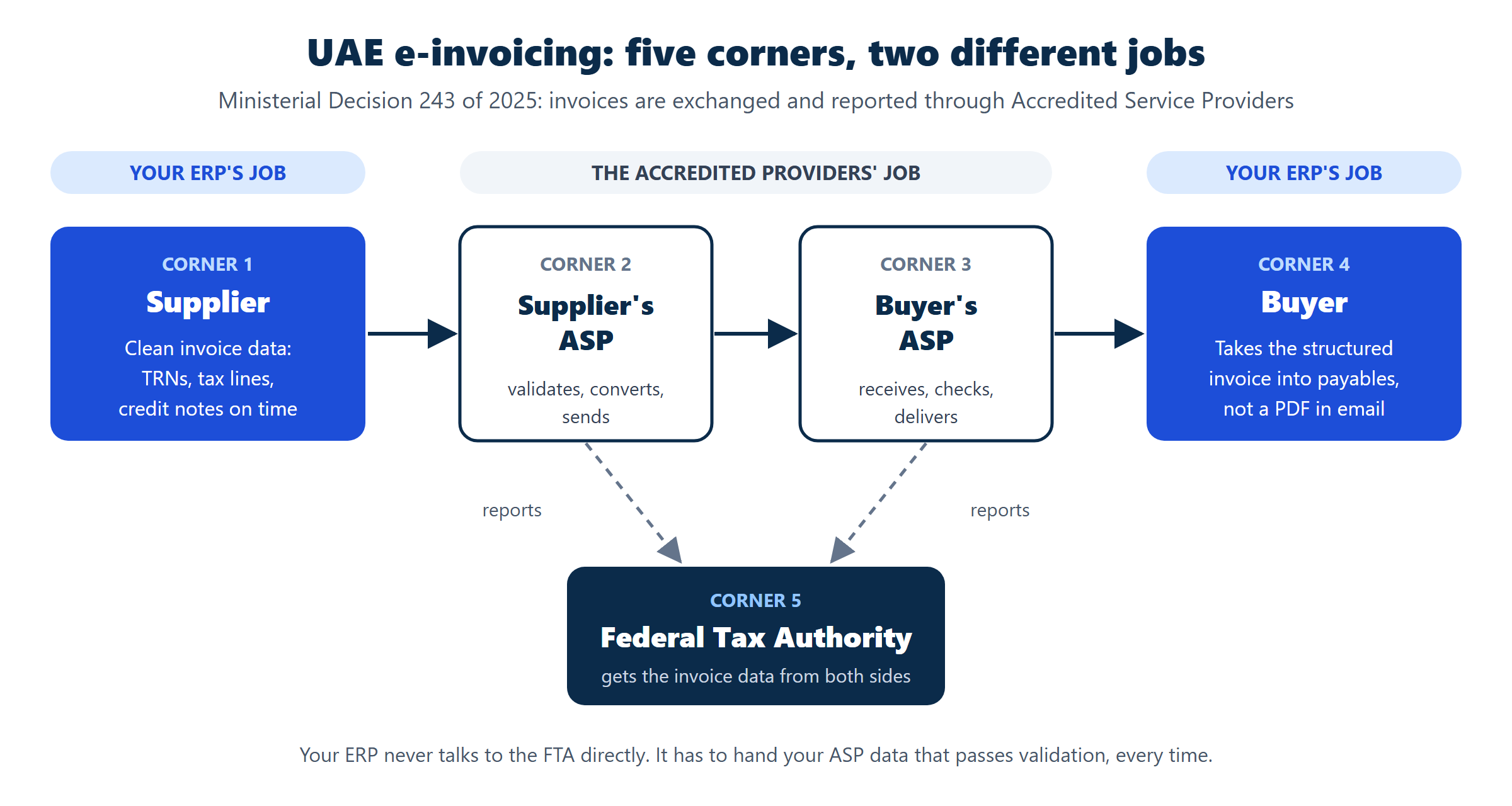
Notice the receiving side, too. Recipients have to process e-invoices through the system and appoint a provider as well. If you buy from UAE suppliers, your payables process needs to take in structured invoices, not just PDFs dropped into an inbox. Plenty of teams plan only for sending, and that’s a mistake.
The penalties, read from the decision itself
The 2025 penalty table has been replaced. Cabinet Decision No. 173 of 2026 repeals Cabinet Decision No. 106 of 2025 and sets these amounts:
- Failing to implement the system, which the decision says includes failing to appoint an Accredited Service Provider: AED 5,000 for the first instance, then AED 5,000 for each month or part month it continues, capped at AED 50,000 in any 12 consecutive months.
- Failing to issue and send an e-invoice through the system: AED 100 per invoice, up to AED 5,000 a month. The same applies separately to credit notes.
- Failing to tell your provider about a change to your FTA-registered data: AED 250 per day of delay, up to AED 5,000 a month.
Two details are easy to miss. If you’re both issuer and recipient for the same violation, you pay one penalty, not two. And businesses that join voluntarily are outside the penalty decision entirely, although every other e-invoicing rule applies to them in full.
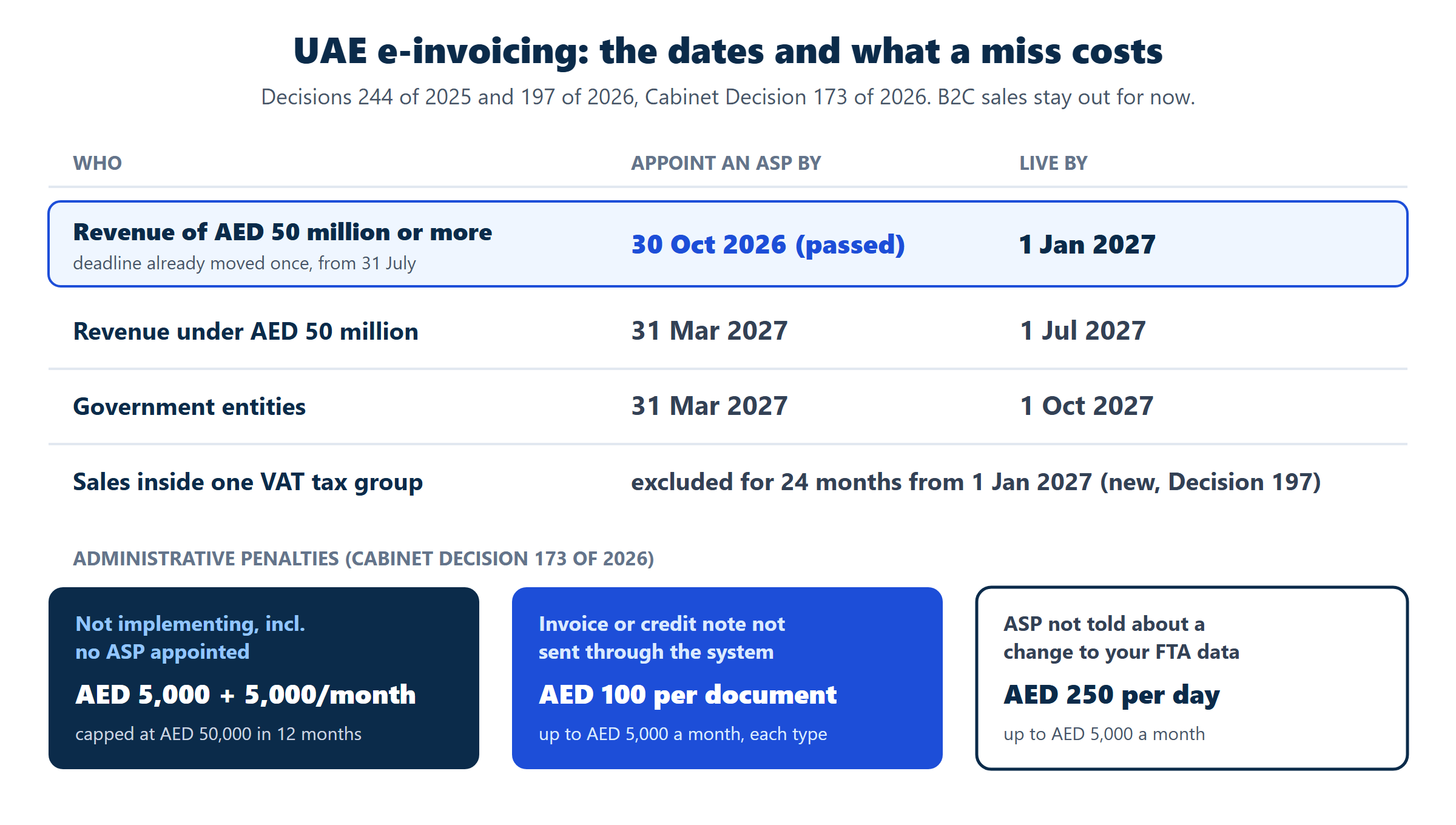
The fines aren’t huge on their own. The real cost is a customer whose provider rejects your invoice, so it doesn’t get paid until you fix it.
What to check in your ERP before 1 January
Most of the work is data hygiene, and you can start it before your provider’s integration is ready. Here’s the order we’d follow:
- Customer and supplier tax numbers. Every UAE business partner needs a correct TRN on its record. Run a report of partners with blank or malformed tax IDs and fix them now, while it’s still cheap.
- Tax set-up per line. Each invoice line has to carry the right VAT treatment. Zero-rated and exempt lines that someone keyed in as “no tax” will fail validation.
- Credit notes, not edits. The decision lists when a credit note is required: a cancelled sale, a reduced price, a full or partial refund, or an administrative or numerical error. If staff quietly edit posted invoices, that habit has to stop.
- Tax group flags. If you’re in a VAT tax group, mark intra-group partners so those sales can be kept apart during the 24-month exclusion, and so you can switch them on cleanly when it ends.
- The hand-off. Find out exactly what your provider accepts: an API, a file drop, or a connector it maintains for your ERP. Then test with real invoices, credit notes and a few odd cases before go-live, not after.
Smaller businesses have until 31 March 2027 to appoint a provider. Don’t read that as a reason to wait. The data clean-up takes the same time whatever your revenue.
Where ICTERP stands today
We’d rather be straight about this. ICTERP is open source ERP built on Odoo Community 19, and its Invoicing app issues invoices and credit notes, keeps each partner’s tax ID and records VAT per line. Odoo Community also ships a UAE accounting package with a chart of accounts, VAT taxes and a tax report.
What it doesn’t do is send UAE e-invoices. When we checked the Odoo Community 19.0 code on 2 November 2026, its electronic invoice formats covered European, Australian, New Zealand and Singapore standards, with nothing listed for the UAE, and the Peppol module’s country list doesn’t include the UAE either. ICTERP doesn’t add a UAE format or a connector to any Accredited Service Provider.
So if you run ICTERP for UAE customers, the link to your chosen provider is an integration project. Some providers publish APIs for exactly this. Where one fits, we can scope the link as a proper add-on through our custom solutions work, with tests and a fixed plan. We won’t pretend it’s already in the box. If you’re comparing editions while you plan this, the editions and prices page shows what each one includes.
Frequently asked questions
Did the UAE extend the 30 October 2026 deadline again?
Not as far as the Ministry’s published decisions show. The deadline was moved once, from 31 July to 30 October 2026, and the Ministry said go-live for businesses with revenue of AED 50 million or more stays at 1 January 2027.
Does UAE e-invoicing cover sales to consumers?
Not yet. Ministerial Decision No. 244 of 2025 keeps business-to-consumer transactions out until the Minister decides otherwise, and a business that sells only to consumers isn’t in scope for now.
Can my ERP send e-invoices straight to the Federal Tax Authority?
No. Under the five-corner model, issuers and recipients meet their exchange and reporting duties through an Accredited Service Provider. Your ERP’s job is to hand that provider complete, valid data.
Do I still have to store invoice data inside the UAE?
No. Decision 197 of 2026 replaced that rule. You now keep e-invoices, credit notes and related data for the period in the Tax Procedures Law and must be able to produce them to the FTA on request.
Is ICTERP ready for UAE e-invoicing?
Partly. It handles invoices, credit notes, tax IDs and VAT lines, and Odoo Community has a UAE accounting package. It doesn’t produce the UAE e-invoice format or connect to an Accredited Service Provider, so that link needs integration work.
What happens to sales inside a VAT tax group?
They’re excluded for 24 months from 1 January 2027. You can still choose to send them voluntarily, in which case the e-invoicing rules apply to those invoices but the penalty decision doesn’t.
Sources
- Ministry of Finance, Ministerial Decision No. 197 of 2026 (in force 1 October 2026)
- UAE Cabinet, Cabinet Decision No. 173 of 2026 on violations and administrative penalties
- Ministry of Finance, Ministerial Decision No. 243 of 2025 and No. 244 of 2025
- Ministry of Finance, announcement of the deadline extension (10 May 2026)
- Ministry of Finance, list of Accredited Service Providers (page updated 2 November 2026)
- Odoo Community 19.0 source, electronic invoice formats by country (checked 2 November 2026)
Want to see ICTERP with your own brand on it? Open a ticket and we'll set up a walkthrough.